Showing posts with label Science. Show all posts
Showing posts with label Science. Show all posts
Friday, March 23, 2012
What Happen's on Friday's At Hillwood
Each Friday Miss Morehead comes in and we do the blog. Miss Morehead is Oliver's mom. The blog is called The Hillwood Herald. The blog is when we wright an artical and post them on the blog. After we do the blog, we have art. Our art teacher is Anna. Anna is Rubina's mom. After art we have lunch and we go to the park. When we come back we have study hall and we have a selling test. On Friday's we have thirty mins of study hall instead of 45 because of our science class which is really fun. On our third time we flew our hang gliders. After the day is over at 3:00, we go down stairs and we watch a movie!

Friday, February 24, 2012
Our New Science Teacher!
At Hillwood we have a new science teacher coming in every Friday to teach us Aerodynamics.


Tuesday, July 12, 2011
Girl Power at the Google Science Fair
 Yesterday, Google headquarters in Silicon Valley hosted fifteen Google Science Fair finalists. More than 1,000 local attendees plus Google workers attended the event and walked along the exhibit halls.
The top three winners are all girls this year, and here they are:
- Lauren Hodge in the 13-14 age group. Lauren studied the effect of different marinades on the level of potentially harmful carcinogens in grilled chicken.
- Naomi Shah in the 15-16 age group. Naomi endeavored to prove that making changes to indoor environments that improve indoor air quality can reduce people’s reliance on asthma medications.
- Shree Bose in the 17-18 age group. Shree discovered a way to improve ovarian cancer treatment for patients when they have built up a resistance to certain chemotherapy drugs.
You can watch the girls' science fair submission on Google. Also, consider checking out the Google Students blog.
Sources: Google Science Fair, Google daily blog
Monday, May 23, 2011
On the Heels of the Maker's Faire, Google Announces Kid Winners of Its Science Fair
The judges for the Google Science Fair just announced the contest's 15 finalists out of 60 semi-finalists. According to the judges, all of the students’ projects asked interesting questions, many focused on real-world problems and some produced groundbreaking science that challenged current conventions.
There were three categories: 13- to 14-year-olds, 15- to 16-year-olds, and 17- to 18-year-olds. In July, the finalists get to visit Google headquarters in Mountain View, California. to present their projects to the panel of finalist judges, including science luminaries, technology innovators and one Nobel laureate. They are vying for prizes that include $100,000 in scholarship funds, real-life experiences at CERN, Google, LEGO and Scientific American, and a trip to the Galapagos Islands courtesy of National Geographic Expeditions. The event will be streamed live on ourYouTube channel so make sure to tune in.
Here are few videos of two of the finalists, the winged keel and a wind turbine:
There were three categories: 13- to 14-year-olds, 15- to 16-year-olds, and 17- to 18-year-olds. In July, the finalists get to visit Google headquarters in Mountain View, California. to present their projects to the panel of finalist judges, including science luminaries, technology innovators and one Nobel laureate. They are vying for prizes that include $100,000 in scholarship funds, real-life experiences at CERN, Google, LEGO and Scientific American, and a trip to the Galapagos Islands courtesy of National Geographic Expeditions. The event will be streamed live on ourYouTube channel so make sure to tune in.
Here are few videos of two of the finalists, the winged keel and a wind turbine:
Friday, February 18, 2011
The Awesome Rubber Band Car Wins!

Erion, Nikita, and I made a rubber band car. We made it differently from the directions told us to, because we wanted it to behave differently. We also had some ideas about how we might make it better. You can read the basic instructions on the PBS Kids website.
Deviating from the directions worked for us! We beat Jake and Zeke's rubber band powered car in a race. The car was fast and could last, or run, a long. We used putty, duct tape, skewers, faucet washers, CDs, and a rubber band to make the vehicle. The cardboard was 5 by 6 inches long. The rubber band car had a extra pair of wheels and customized wheels.


Friday, January 14, 2011
A Heartbreaker: Teens Struggle to Resist Sugar
 SUGAR, SUGAR, SUGAR, SUGAR, SUGAR.
It's true: Teens are officially "addicted" to sugar -- and that could mean trouble for their hearts as they grow older.
If you think about it, many teens eat for breakfast sugary cereal and syrup waffles. For lunch, they drink soda. Soda is actually the main culprit when it comes to a kid's sugar consumption.
In a study, teens who consume added sugar -- again, usually found in sweetened beverages -- had a higher risk for heart problems latter in life. This sugar makes up 1/5 of their daily calories. This website NPR will give you more info on haw to keep your teens healthy. You can also go this website by the Harvard School of Medicine to read a list of all the different names for sugar. This list could be helpful when someone is trying to figure out how much sugar is in the ingredients of a drink or food item.
- Agave nectar
- Brown sugar
- Cane crystals
- Cane sugar
- Corn sweetener
- Corn syrup
- Crystalline fructose
- Dextrose
- Evaporated cane juice
- Fructose
- Fruit juice concentrates
- Glucose
- High-fructose corn syrup
- Honey
- Invert sugar
- Lactose
- Maltose
- Malt syrup
- Molasses
- Raw sugar
- Sucrose
- Sugar
- Syrup
Here is a video to highlight my story:
Friday, January 7, 2011
Exploritorium Exhibit of "Science in the City" Opens
 The Exploratorium is having a new exhibit called Science in the City. The exhibit answers questions about San Francisco like "Why are there so many one-footed pigeons?, Where does sewage go?, Who--or what-coordinates traffic lights?," and more.
You should visit locations in and around San Francisco for explorations of engineering, ecology, optics, waves, geology, architecture, weather and more. If you want more information go to the Exploratorium website. Also, if you looking for something to do on Martin Luther King Day, you may want to consider day camp at the Exploratorium.
The following is our video about this story:
Scientists Discover More About Light Science
 Scientists would like to learn more about science, so they set up labs in three places: a mountain near Japan, underground on the border of Switzerland, France, and on the side of a mountain near the Arctic Circle according to Scholastic.
These scientists are learning about particles and other science things by, for example, under the mountain near Japan, they built somewhere called a Super-K.
 "The Super-K is six-story-high located more than a mile below Mount Ikenoyama. Inside, walls lined with light-sensing detectors surround a pole of water. When a neutrino hits the water, a tiny cone of light. The detectors see the light and send information about the neutrino to computers."
Friday, November 5, 2010
A Big Thank You to Adam and Judy

Sparkfun, a website that Adam and Judy recommend to us, is basically a website that has all sorts of hands-on science experiments, from flying ghosts to lillypad class. For those of you who do not know what Lillypad class is, it is a class that is "Just in time for that Halloween costume, SparkFun is offering a LilyPad Basics Workshop!"

This class filled up quickly, but the website's staff decided to open a few more spots. The class takes place on October 21st at 6 PM and is designed with the beginner in mind. We'll explain how to build simple circuits into almost any fabric!"
 The picture below is the frount page on the website.
 In the photo to the left, I am building a hidden alarm challenge.
Friday, October 22, 2010
White House Science Fair!
President Obama is having a middle school high school White House Science Fair ! There are robots, solar cars, and rockets!
There are robots that play soccer, Ninth graders building planes, concoctions that could cure cancer, and electric wheelchairs!
At this fair comes Mythbusters! and Bill Nye the Science Guy!
President Obama Wants America to be number one in science and math not the twenty first.
This is part of his speech:
Adam and Judy went to meet some of the winners!
Maryann made a smarter toilet. A toilet that has a gallon bottle filled with water so that there toilet thinks it has more water in it then it actually does.
Daniel made a MiBike a bike that can go in rain or shine. It has a shower curtain over the bike so that the bike has protection against blazing sun and pouring rain!
Lilly made a Sibling Soaker, a dunking booth with out the booth! She put a bunch of balloons in a tube with holes at the end when she hits something the balloons burst and pore out the tube on to the victim!
There are robots that play soccer, Ninth graders building planes, concoctions that could cure cancer, and electric wheelchairs!
At this fair comes Mythbusters! and Bill Nye the Science Guy!
President Obama Wants America to be number one in science and math not the twenty first.
This is part of his speech:
The importance of tapping this potential is why we’re here. It’s why I wanted to host this fair, which culminates this weekend in a science and engineering festival on the National Mall and across the country where more than a million people are expected to participate.
So we welcome championship sports teams to the White House to celebrate their victories. I've had the Lakers here. I’ve had the Saints here, the Crimson Tide. I thought we ought to do the same thing for the winners of science fair and robotic contests, and math competitions. Because often we don’t give these victories the attention that they deserve. And when you win first place at a science fair, nobody is rushing the field or dumping Gatorade over your head. But in many ways, our future depends on what happens in those contests -- what happens when a young person is engaged in conducting an experiment, or writing a piece of software, or solving a hard math problem, or designing a new gadget.
It’s in these pursuits that talents are discovered and passions are lit, and the future scientists, engineers, inventors, entrepreneurs are born. That's what’s going to help ensure that we succeed in the next century, that we're leading the world in developing the technologies, businesses and industries of the future.You can learn more about his speech at White House!
Adam and Judy went to meet some of the winners!
Maryann made a smarter toilet. A toilet that has a gallon bottle filled with water so that there toilet thinks it has more water in it then it actually does.
Daniel made a MiBike a bike that can go in rain or shine. It has a shower curtain over the bike so that the bike has protection against blazing sun and pouring rain!
Lilly made a Sibling Soaker, a dunking booth with out the booth! She put a bunch of balloons in a tube with holes at the end when she hits something the balloons burst and pore out the tube on to the victim!
Friday, October 15, 2010
Questions for Adam and Judy

Next Friday, PBS Kids' DESIGN SQUAD's Judy and Adam will be visiting The Hillwood Herald. As news reporters for the blog, we'll be interviewing them about who they are, what they do, and how they came to create all these challenges for PBS Kids.org. We're also going to be able to show them all the projects we have made with their neat ideas.
Here are some questions that I will ask them:
Here are some questions that I will ask them:
- Why did our hidden alarm work with 1 AA battery and none of the others did?
- What made you two decide to create this show?
- At any point, did you two either get so frustrated or bored that you gave up on the project?
- What was the hardest project you two did?
- How long has this show been running for?
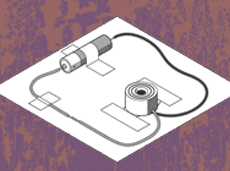
On the Sly: The Hidden Buzzer

We needed a little help to make it work reliably so Graham made some changes and connected the wire with a paper clip of course -- it worked!
If you want to try the Hidden Alarm Challenge yourself, go to the PBS Kids DESIGN SQUAD web page. You can watch videos of the experiment. Then you can go to this page for instructions and the needed supplies.
If you want to try the Hidden Alarm Challenge yourself, go to the PBS Kids DESIGN SQUAD web page. You can watch videos of the experiment. Then you can go to this page for instructions and the needed supplies.
As you know, Judy and Adam are coming to talk to us and see our experiments. Here are some questions I'll ask them:
1. Do you practice the experiments before you video tape them?
2. Do you make up the experiments? If not, where do you get the ideas?
3. Where do you make the experiments?
4. What did you want to be when you were little? When did you want to become engineers?

I can't wait to hear wait Adam and Judy talk to us about there experiments!
Friday, September 10, 2010
Albino Alligators — And Happy Birthday, Claude!

Today is Claude's birthday! He is 15 now. He lives in the Academy of Science. Claude is an Albino Alligator, a rare type of alligator, first discovered in 1987.
Today, Claude will get cupcakes made of gator chow. If you visit the Academy of Science from September 8 to 15, you can make a alligator insipered birthday hat, or design a birthday cake for Claude.
Today, Claude will get cupcakes made of gator chow. If you visit the Academy of Science from September 8 to 15, you can make a alligator insipered birthday hat, or design a birthday cake for Claude.
Friday, July 23, 2010
How Did the Caterpillar Cross the Road?
 Have you ever thought about how a caterpillar moves? A science student Tufts University is study asking that question. For him and others, it may help answer bigger questions about movement and robotics.
 As NPR explains, one type of caterpillar thrusts its gut with movement forward. That means, the caterpillar "leads with its gut." According to the research student, this movement is "an entirely new mode of animal locomotion. He hopes this might lead to big discoveries in the worlds of robotics and medicine.


You can both listen to a radio broadcast on the caterpillar movement or watch a video at NPR's website.
Wednesday, July 7, 2010
Ten Dimensions - and How They Work
Sunday, May 23, 2010
Australia Allows Exports of Uranium to Russia

Australia is the world's third largest uranium producer. Not a long time ago, Australia allowed uranium to be exported to Russia. The problem is that it was only Russia. Australia has refused to sell uranium to India. Australia refused to sell it to India for energy use because the South Asian country has not signed the Nuclear Nonproliferation Treaty.
Russia is lucky to be the country that Australia sells Uranium to. Russia hopes that "agreements on the peaceful use of nuclear energy" will be complete. Also, Australia and Russia both signed up to President Barack Obama's plan to secure all vulnerable nuclear material in four years outlined at two-day summit in Washington earlier this month. This had to involve forty-seven countries.
Friday, May 21, 2010
The Maker's Faire
Have you ever had some totally bizarre idea or creation? Or maybe you wanted to make a Hamburger Car? Well, you probably didn't know that their is a huge convention were people can show off these creations. At the Makers Faire, go watch a giant, mega, troll size version of the Mouse Trap Game.
This weekend at the Sam Mateo County Event Center, May 22 to May 23, Come join all the fun and wackiness that you could handle. There is going to be food and games for all ages. Click here to find out more about it.
This weekend at the Sam Mateo County Event Center, May 22 to May 23, Come join all the fun and wackiness that you could handle. There is going to be food and games for all ages. Click here to find out more about it.
Friday, March 19, 2010
My Top Picks


 This article is about different kinds of germs on your hand. Researchers in the US have found out there are many different kinds of germs living on our hand. They found out by swabbing on someones key board and match the bacteria of the computer owner.
Even on the most clean person have 150 different kinds of bacteria on our hands. Each person leave different kind of bugs on there daily lives. A team of scientists led by professor Noah Fierer from the University of Colorado in Boulder, US was able to match samples of bacteria in 3 computer keyboard. You can wash your hands, use your your arm when you sneeze, brush your teeth, and take a shower.
By Brandon
I would reduce ,reuse ,and recycle.
When I grow up I will be a video game tester.
My favorite science posts are the The Engineering of Ok Go , Animal Myths Heres the truth , and Pierre's Wetsuit Works.
I like the Golden Gate Bridge because people use their time to make the bridge China town because I can see my grandma , Six Flags because that was the first amusement park I went , and The A and T stadium because that was my first baseball game and it is home of the Giants.
What I like in Hillwood is going to the parks , the field trips , and the field trips.
Hillwood is a good school , they have nice teachers , you can go to the park , the upper class has a computer class , you can play chess , and on Friday after 3:00 you use your electronics.
In 20 years will have cars that can fly , cars that run on solar energy , and have flying shoes.
We can put the lower-grade's picture , they can take pictures , or they can put a story that they wrote.
Thomas Edison: His Biography
 Thomas Edison, was born on February 11, 1847. Edison was born in Milan, Ohio. At the age of 12, he was a victim of ADHD, or attention deficit hyperactive disorder. Edison then became a scientist.
In the years of 1863 to 1868 he was a telegrapher. He then invented the light bulb, the first electric vote recorder, motographer,and an automatic telegrapher. One of his inventions, the light bulb, is used in every home today.
To find out more about Tomas Edison, visit this Wikipedia page about Edison or this one about his inventions.
Friday, March 12, 2010
Hippocrates of Cos: The Western Father of Medicine
 Each semester (two in total of one school year), the upper graders write a report about a designated topic. During the fall semester, we wrote reports about countries. This time, we are reporting on scientists.
For my semester report, I have chosen Hippocrates of Cos, an ancient Greek Physician. He learned medicine from his father and grandfather, as they were also both somehow connected to those fields of study. Little is known about his childhood but studies show that he had two sons, Thessalus and Draco, along with a son-in-law, Polybus. According to Galen, also a Greek physician, Polybus was Hippocrates' true successor and he also became a physician. It is not know when Hippocrates passes away. Some say 83, some say 90 while others believe he lived to be beyond 100 years old.
All sources and picture from Wikipedia
Subscribe to:
Posts (Atom)